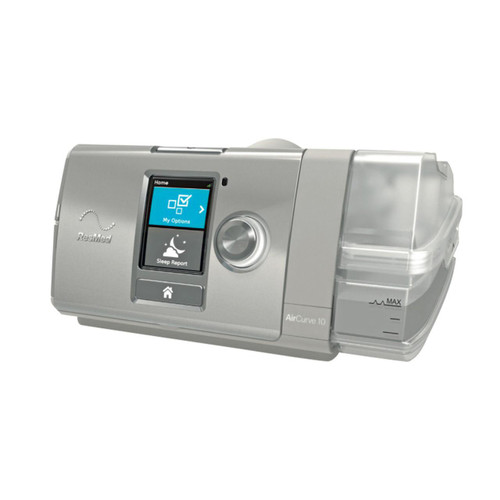


Description
For the next-level therapy experience
For patients who benefit from pressure support
The AirCurve 11 delivers bilevel therapy with adaptive pressure support designed to stabilise breathing and personalise therapy for patients with CSA (Central Sleep Apnea), OSA (Obstructive Sleep Apnea), mixed apneas, or periodic breathing.
AirCurve 11 highlights
AirCurve™ 11 helps deliver improved therapy outcomes through proven algorithms and the personalised features of the Air11™ platform, underpinned by bilevel therapy providing higher pressure on inhalation (IPAP) and lower pressure on exhalation (EPAP)
Sleek, modern design helps reduce the stigma of having a PAP device on
the nightstand.
Touchscreen makes navigating settings simple and intuitive.
Integrated cellular and Bluetooth® communication
Cellular connectivity≠ enables secure and automated data transmission to the
cloud for access in AirView and myAir. Bluetooth connectivity to myAir assists
with device setup for a more interactive therapy experience
Integrated heated humidifier Can be automatically controlled through the Climate Control feature or manually set by the user.
Most suitable for treating central sleep apnea
Standard therapies are often unable to fully normalise breathing for patients with
pauses in breathing due to the absence of respiratory efforts. These patients may
present with central sleep apnea, obstructive sleep apnea, mixed apneas or periodic breathing, leading to discomfort and arousals.
How the ASV algorithm works
Leveraging Breath Phase Mapping technology, the algorithm rapidly increases pressure support in response to minute ventilation decrease to maintain
it at the target.
The algorithm gradually reduces pressure support to a comfortable minimum once breathing is stabilised to prevent over-ventilation or hypocapnia.
Key elements of the algorithm
ASV and ASVAuto
1. Adaptive pressure support
Designed to counterbalance ventilatory instability, pressure support (PS) auto-adjusts between the Min PS and the Max PS to maintain each patient’s unique minute ventilation target (tidal volume and respiratory rate) while maintaining patient-device synchrony and comfort.
2. AutoEPAP (ASVAuto only)
Auto-adjusts expiratory positive airway pressure (EPAP) within the allowed range (Min EPAP and Max EPAP) to maintain upper airway patency
3. Auto backup rate
Uses breath phase mapping to provide a timed backup rate synchronised with the patient’s own breathing to maintain the target minute ventilation
in the case of apneas.
When can ASV therapy be prescribed?
Guidelines state that ASV therapy can be prescribed in several clinical
situations. The ERS statement on central sleep apnea, the AASM
guidelines, and various statements confirm that ASV is eligible and
may be useful, effective and safe in these clinical situations:
• Central sleep apnea in heart failure with preserved ejection
fraction (LVEF > 45%)
• Central sleep apnea associated with long-term drug therapy without alveolar hypoventilation
• Idiopathic central sleep apnea or Cheyne-Stokes respiration
• Treatment-emergent/persistent central sleep apnea
• Central sleep apnea after ischemic stroke